


Page 8 - DrivingTourBooklet2020
P. 8
Park sign. Turn left and drive until you see Lilly Park, the mouth of the   other, of a similar kind, those men began to sing, and beet the tamboreens.
           Bad River and the Lewis & Clark Center. The mouth of the Bad River,         The women came forward highly deckerated in their way, with scalps and
           although subject to 200 years of accretion and erosion, is still similar to   trophies of war of their fathers, husbands, brothers or near connections
           the time when Lewis and Clark were there.                                   and (joined by five or six of the young men) proceeded to dance the War
        4. Verendrye Monument. After you have been to viewing points 2 and 3           Dance...which they done with great cheerfulness until about 12 o’clock.”
           above, drive to the top of the Verendrye Monument in the city of Fort       By that time the captains needed to retire for the evening. They returned
           Pierre. Here you can see                                                    to the keelboat, still anchored in the same place, accompanied by two
           La Framboise Island, the                                                    chiefs who stayed with them all night.
           curve of the Missouri
           River, the mouth of the
           Bad  River,  the  plain  to
           the  north  between  the
           Bad River and Oahe
           Dam, as well as the cities
           of Pierre and Fort Pierre.

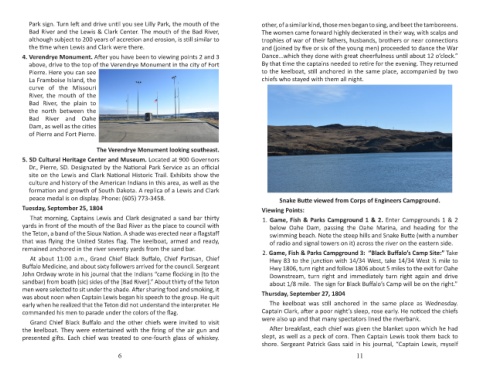
                                    The Verendrye Monument looking southeast.
        5. SD Cultural Heritage Center and Museum. Located at 900 Governors
           Dr., Pierre, SD. Designated by the National Park Service as an official
           site on the Lewis and Clark National Historic Trail. Exhibits show the
           culture and history of the American Indians in this area, as well as the
           formation and growth of South Dakota. A replica of a Lewis and Clark
           peace medal is on display. Phone: (605) 773-3458.                                 Snake Butte viewed from Corps of Engineers Campground.
        Tuesday, September 25, 1804                                                    Viewing Points:
           That morning, Captains Lewis and Clark designated a sand bar thirty          1. Game, Fish & Parks Campground 1 & 2. Enter Campgrounds 1 & 2
        yards in front of the mouth of the Bad River as the place to council with         below Oahe Dam, passing  the Oahe  Marina, and  heading  for the
        the Teton, a band of the Sioux Nation. A shade was erected near a flagstaff       swimming beach. Note the steep hills and Snake Butte (with a number
        that was flying the United States flag. The keelboat, armed and ready,            of radio and signal towers on it) across the river on the eastern side.
        remained anchored in the river seventy yards from the sand bar.                 2. Game, Fish & Parks Campground 3:  “Black Buffalo’s Camp Site:” Take
           At  about  11:00  a.m.,  Grand  Chief  Black  Buffalo,  Chief  Partisan,  Chief   Hwy 83 to the junction with 14/34 West, take 14/34 West ½ mile to
        Buffalo Medicine, and about sixty followers arrived for the council. Sergeant     Hwy 1806, turn right and follow 1806 about 5 miles to the exit for Oahe
        John Ordway wrote in his journal that the Indians “came flocking in (to the       Downstream,  turn  right  and  immediately  turn  right  again  and  drive
        sandbar) from boath (sic) sides of the [Bad River].” About thirty of the Teton    about 1/8 mile.  The sign for Black Buffalo’s Camp will be on the right.”
        men were selected to sit under the shade. After sharing food and smoking, it
        was about noon when Captain Lewis began his speech to the group. He quit       Thursday, September 27, 1804
        early when he realized that the Teton did not understand the interpreter. He      The  keelboat  was  still  anchored  in  the  same  place  as  Wednesday.
        commanded his men to parade under the colors of the flag.                      Captain Clark, after a poor night’s sleep, rose early. He noticed the chiefs
           Grand Chief Black Buffalo and the other chiefs were invited to visit        were also up and that many spectators lined the riverbank.
        the keelboat. They were entertained with the firing of the air gun and            After breakfast, each chief was given the blanket upon which he had
        presented gifts. Each chief was treated to one-fourth glass of whiskey.        slept, as well as a peck of corn. Then Captain Lewis took them back to
                                                                                       shore. Sergeant Patrick Gass said in his journal, “Captain Lewis, myself
                                        6                                                                              11

